Case Study
How Sleep.me Fixed Their Funnel and Lifted AOV 41%, Without Slashing Prices
Sleep.me didn't lower prices. They didn't just run a sale. They fixed the funnel. And they lifted their average order value by 41% in the process. Here's how they did it.

The Problem: Great Product, Broken Path
Sleep.me makes the Chilipad, a bed cooling system that helps people sleep better by regulating temperature. It's not a $20 impulse buy. It's a premium product that requires education, trust, and a clear value story.
But here's what was happening:
High-intent shoppers were hitting product pages too early. They hadn't been educated on why temperature matters for sleep quality. They didn't understand why the bundle was the best option. And they definitely weren't ready to drop hundreds of dollars without more context.
The result ended up with lower conversion rates. Depressed average order values. Revenue left on the table.
But the real issue wasn't the product or the price. It was the path.

The Stack Underneath Was Fighting Them
Like most growing ecommerce brands, Sleep.me's marketing stack had grown organically. A tool here. Another platform there. Each one solving an immediate problem, but nobody stepping back to ask: “How does this all work together?”
The result:
- Disconnected data flows between their ecommerce platform, marketing automation, and analytics
- No unified customer view across touchpoints
- Limited ability to create guided journeys for their education-heavy products
- Data silos that made attribution nearly impossible
For a company selling premium sleep technology, these gaps translated directly to lost revenue.
The Decision: Fix the Foundation, Then the Funnel
Sleep.me made a smart call. Instead of just adding another tool to the pile, they decided to rethink their architecture.
They brought in McGaw to help. And the first step wasn't buying anything new. It was building a proper data foundation.
Step 1: Build the Data Infrastructure
You can't personalize if your customer data is scattered across six different tools.
With the help of McGaw, Sleep.me implemented Segment. A CDP (customer data platform) that created a single source of truth for all customer interactions.
What did this unlock?
- Consolidated customer data from every touchpoint
- Accurate attribution models so they could see what was actually driving results
- Personalized experiences powered by unified data
- Seamless integrations with all their existing tools
Step 2: Strategic Tool Selection (Enter ConvertFlow)
Once the data foundation was solid, Sleep.me identified a critical gap: they needed better control over their conversion funnel, especially for high-value bundle offerings.
They were sending paid traffic straight to product pages. And for premium, education-heavy products? That's like proposing on the first date.
McGaw recommended ConvertFlow. Here's why it made sense:
- Native integrations with their CDP, marketing automation, and analytics
- No developer dependencies, the marketing team could build, test, and iterate independently
- Purpose-built for guided funnels that premium products require
- Seamless ecommerce connection in Shopify for transaction tracking
ConvertFlow wasn't chosen in isolation. It was chosen because it integrated perfectly with the unified stack architecture they'd already built.
Step 3: Implementation Without the Usual Chaos
McGaw handled the technical implementation, ensuring ConvertFlow connected seamlessly with:
- Their CDP for unified tracking and attribution
- Their marketing automation platform for triggered campaigns
- Their analytics infrastructure for performance measurement
- Their ecommerce platform for product and transaction data
One integration. All the tools working together. No data silos.
The Strategy: Guided Funnels for Premium Products
Armed with ConvertFlow and a properly integrated stack, Sleep.me's marketing team built a high-converting funnel strategy for their Holiday Bundle campaign.
The Core Problem They Were Solving
High-ticket products don't convert well through product pages alone. They need narrative, clarity, and a focused path.
Sleep.me built their funnel around three principles:
- Recover intent immediately when it begins to drop
- Guide shoppers toward the highest-value configuration
- Educate before you sell
Tactic #1: The Landing Page That Sells Bundles
Sleep.me used ConvertFlow to build a dedicated landing page designed to sell premium bundles by controlling the entire narrative:
- Clear value framing and benefit hierarchy
- Bundle pathway exploration that guided decision-making
- Strategic social proof placement
- Focused CTAs designed to drive premium bundle purchases
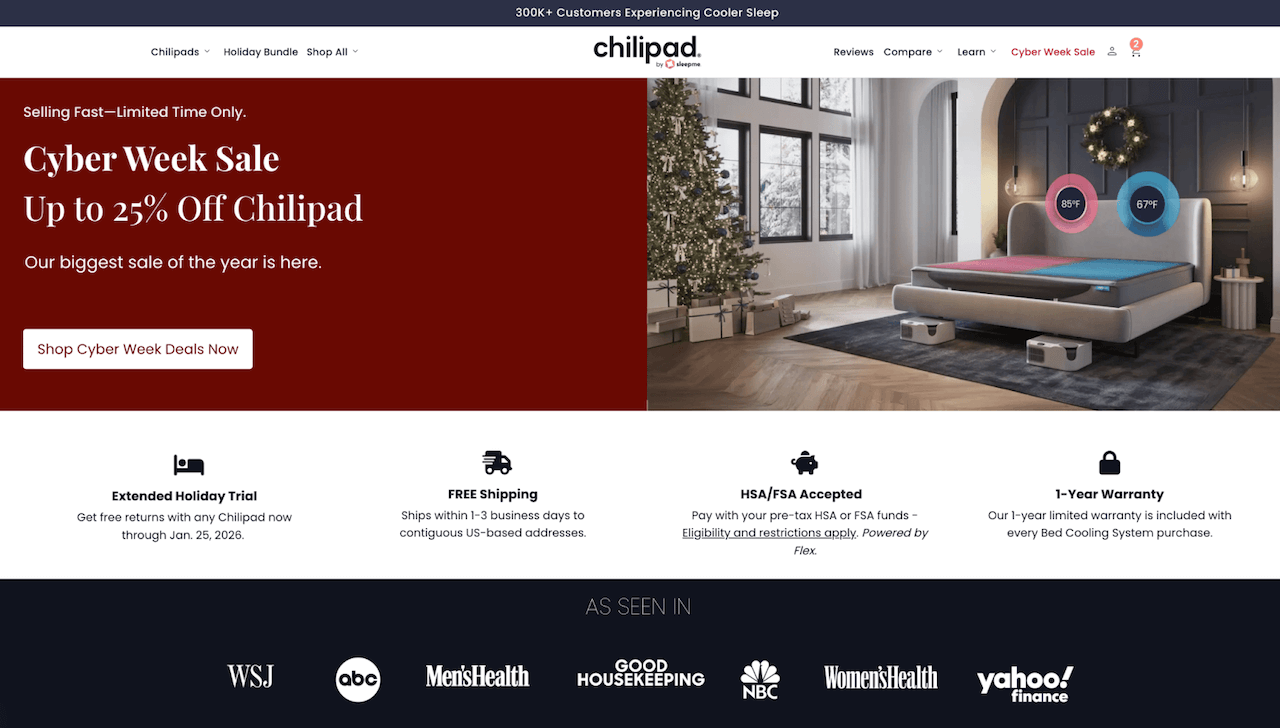
Sleep.me's ConvertFlow-powered landing page for the Chilipad Holiday Bundle
The landing page became the central decision-making hub for holiday shoppers. It turned cold and warm traffic into educated, high-AOV buyers before they ever reached product pages.
Tactic #2: Exit-Intent That Routes Back to Value
Holiday visitors often leave before fully understanding why Sleep.me's systems are worth the investment.
Their ConvertFlow exit popup countered this by:
- Routing shoppers back into the strongest revenue path
- Matching the landing page's design and messaging (no confusion, no leaks)
- Using one clear CTA
- Reinforcing the same premium bundle
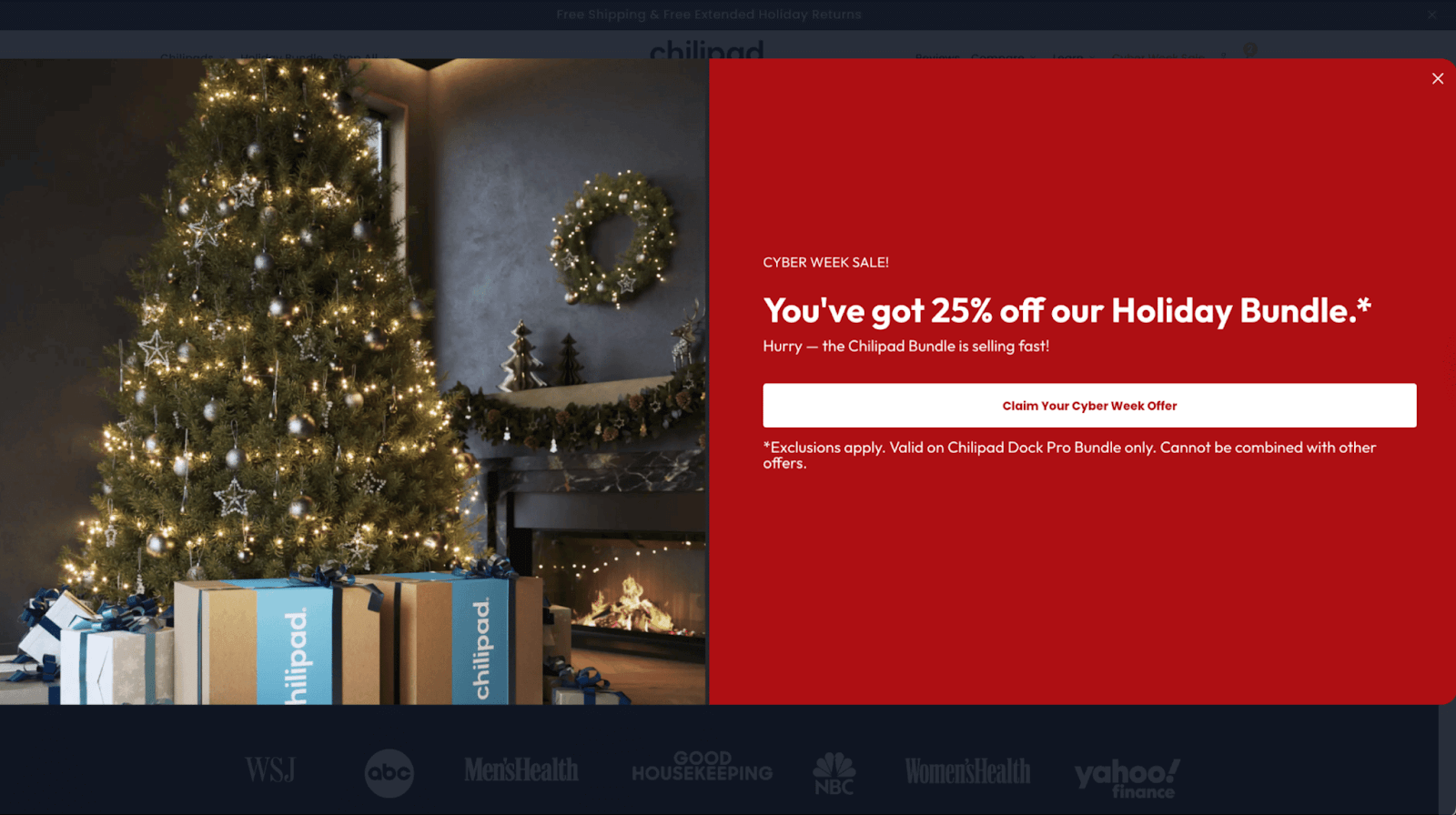
The exit-intent popup reinforced the bundle offer at the moment intent dropped
Because it guided abandoners straight back into the bundle path, the popup played a measurable role in the 41% AOV lift.
How the Full System Worked Together
This wasn't a single-tool win. It was a unified stack working as a system:
And because ConvertFlow was integrated through their CDP, Sleep.me could:
- Track the full customer journey from initial touch to purchase
- Trigger follow-up campaigns based on funnel behavior
- Attribute revenue accurately across the entire funnel
- Iterate rapidly without waiting on development resources
The Results: What Happens When You Fix the Path
Following their stack transformation and ConvertFlow implementation, Sleep.me achieved:
- 41% increase in AOV compared to their baseline store funnel
- One of their strongest seasonal revenue periods driven by the optimized bundle funnel
- Thousands of abandoning shoppers re-engaged and converted at higher values
- Increased conversion rates across the entire funnel
- Rapid iteration capability for their marketing team without developer bottlenecks
These results weren't achieved by a landing page tool alone. They were the outcome of a strategically integrated MarTech stack where every tool worked together.
“There's a reason the phrase 'you can lead a horse to water' is a cliché. The same principle applies to customers: people are smart. When you leave the ego at the door and guide the conversation, even within a structured digital experience, the results speak for themselves: a 41%+ increase in AOV.”
The Pattern Most Brands Miss
Here's what most ecommerce brands do wrong:
They treat their MarTech stack like a junk drawer. Need a new capability? Throw in another tool. Each one solves an immediate problem. But over time, all those quick fixes create disconnection, data silos, and missed revenue.
Sleep.me took a different path. They fixed the foundation first. Then they added tools that integrated cleanly with that foundation.
The result was a 41% lift in AOV without discounting. Thousands of recovered shoppers. And a marketing team that could move faster, not slower.
Want to See How Your Stack Stacks Up?
Sleep.me's success shows what's possible when your marketing technology actually works together. Whether you're evaluating new tools like ConvertFlow or optimizing your existing stack, the architecture matters as much as the features.
